
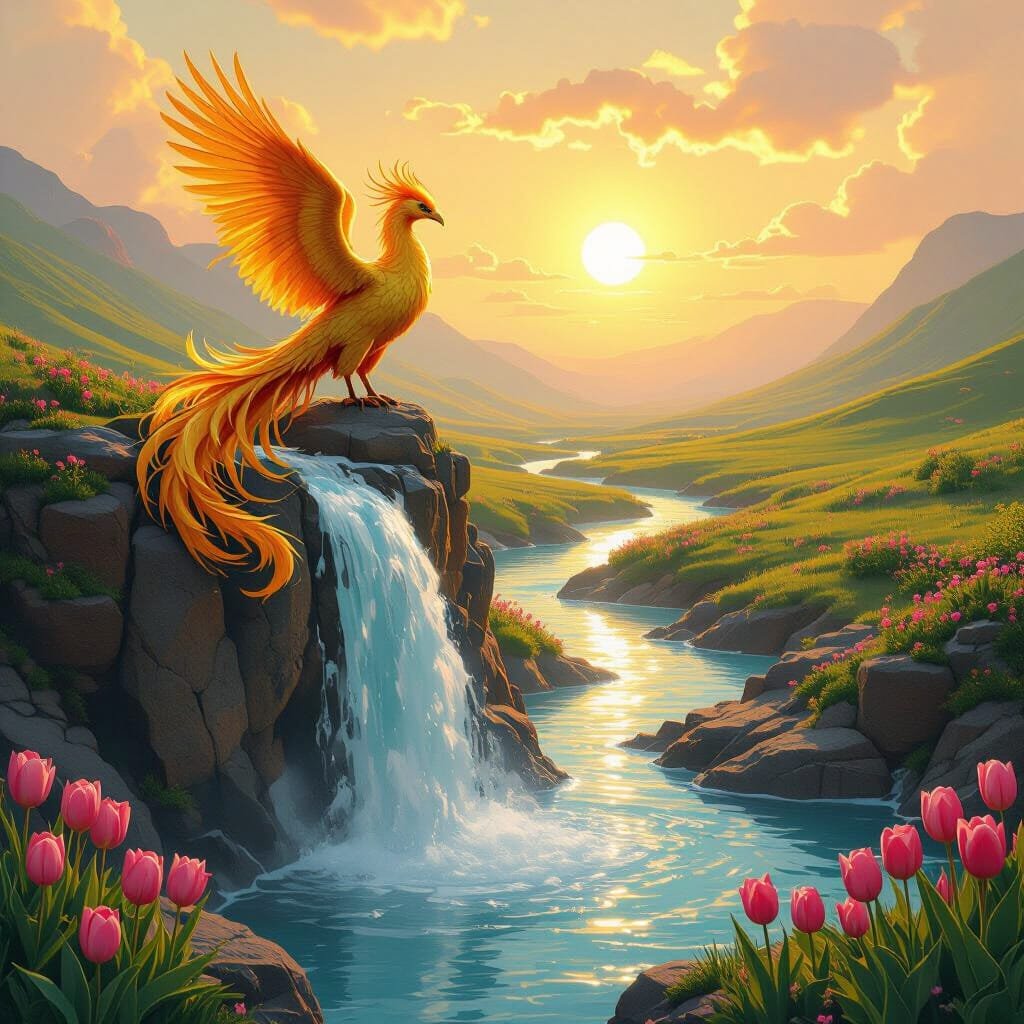
Kaelen had been walking for six days when the fog finally broke and let him see it: a river of captured sunlight, falling three hundred feet into a valley no map had ever agreed to hold still long enough to draw.
He almost turned back. Six days of nettles and switchback trails for a waterfall — however he’d start explaining that to the men waiting for him at the tavern in Ashvale, it wasn’t going to sound like the fortune they’d sent him to find.
Then the light on the cliff above the falls moved, and he understood he hadn’t come for the water at all.
She was larger than the stories allowed — wings the span of a ship’s mast, feathers running amber to a gold so deep it looked poured rather than grown, and a tail of seven flame-ribbons that trailed the black stone without ever touching it. Solmira. He knew her the way you know a name you were told as a child and never quite believed.
She didn’t move to strike him, and she didn’t move to leave. She simply watched, the way something ancient watches something new to see what it does with the silence.
Kaelen had come to Veyrasil chasing a debt he owed three men he didn’t like, for a fortune he’d half-invented to buy himself six more days on the road. Standing under Solmira’s gaze, both of those reasons went quiet in his chest, the way a room goes quiet when someone finally says the true thing everyone had been dancing around.
“I don’t actually know what I came here for,” he said aloud, to a bird, on a cliff, alone.
Solmira tilted her head, unbothered, and for one unguarded moment Kaelen felt something he hadn’t expected to feel that far from home: the sense of being exactly, precisely where he was supposed to be — not because a map or a debt had put him there, but because some older, quieter part of him had been walking toward this valley long before his boots ever agreed to it.
He stayed until dusk. He never did explain it properly to the men in Ashvale. But he went back to Veyrasil twice more before the year was out, and both times, Solmira was waiting on the same black stone — as if some part of her had been walking toward him too.